 Search
Teaching your new puppy or dog where to relieve themselves is an essential step in having a clean home and a well-mannered companion. A consistent, positive approach builds your dog’s confidence and strengthens your bond in the process.1 While every dog learns at their own pace, patience and routine are the key to success when it comes to house training.2
Let’s walk through every stage of house training your puppy or adult dog — from setting schedules and using rewards to handling accidents and overcoming common challenges — to set you and your pup up for success.
How Often Do Dogs Need to Pee?
A general rule of thumb is that a puppy can hold its bladder for the same number of hours as they are in months, up to about 9 to 12 months.3 You’ll likely need to take your pup out every one to four hours, depending on their age, even if they’re just awake and hanging out with you around the house.2
All puppies are different, but there are certain times that most puppies will need to go out, so you’ll want to start adding potty breaks into their schedule:2
- First thing in the morning (though you may need to take out young puppies overnight as well)
- After being in their crate3
- After eating or drinking
- After playing
- After waking up from a nap
- Before going to bed at night3
Signs your dog may need to go out
While training your puppy or dog, they aren’t always going to go to the door or the designated spot, so you’ll want to supervise them at all times (or use a crate for when you aren’t home/can’t watch them, but more on that later) and look for signs like:2
- Abruptly stopping what they’re doing to squat
- Becoming restless
- Sniffing and/or circling
- Whining or scratching at their crate3
Preparing to House Train Your Dog
Consistency really is the key for teaching your puppy or dog where they should be eliminating, so first decide where you want them to go: at a designated spot outside (the front yard, by the fence in the back yard, in front of the apartment complex, etc.) or on a pee pad/indoor potty system.2
Taking your dog outdoors and also using pee pads indoors can be confusing for your puppy or dog, so it’s better to choose one or the other during training when possible.3
It is also helpful to have cleaning products that neutralize the odor so that if — or when — an accident occurs, you can clean it up and your pup won’t try to go there again.2
If your pup continues to pee in the same spot, you didn’t clean up the previous mess properly. Make sure you have an enzymatic cleaner to fully remove the scent.2
5 Steps to House Train Your Puppy or Dog
Follow these key steps to help your companion quickly learn the rules of your home.
- Watch your puppy at all times. This means keeping them on a leash if necessary so that they can’t get more than 10 feet away from you, or using a crate or pen when you can’t supervise them.2
- Take them out on a routine and be patient. Take them to the same place every time and give them a few minutes to sniff around and do their business.2
- Praise and/or reward them when they go. Whether your puppy likes attention or a treat, give them a reward while you’re still outside or immediately after they go on the potty pad.3
- Don’t punish them if they go in the house. If you catch your puppy or dog in the act, distract/grab them and get them to the designated spot, praising them if they finish there.3 If you do not catch them in the act, clean up the mess and decide if you either need to let them out sooner or supervise them better. If you punish, strike or rub their nose in it, your dog may become fearful of you — but will also learn to hide and urinate or defecate only when humans aren’t around.2
- Add a cue. Once you are able to recognize the signs that your puppy or dog needs to go out, start introducing a cue like “go potty.”2
House training puppies vs. adult dogs
If you’ve adopted an adult or senior dog, there are a few reasons why an older dog may not be house-trained:
- Adjusting to their new home/routine4
- Arthritis or other pain that makes it difficult to lift their leg or squat5
- Cognitive decline5
- Incontinence or another medical issue5
- Never trained in the first place4
- Not able to hold it as long as they used to5
That being said, all of the tips above still apply: build a consistent routine, watch for their signals and, above all else, be patient.4
Crate Training as a House-Training Tool
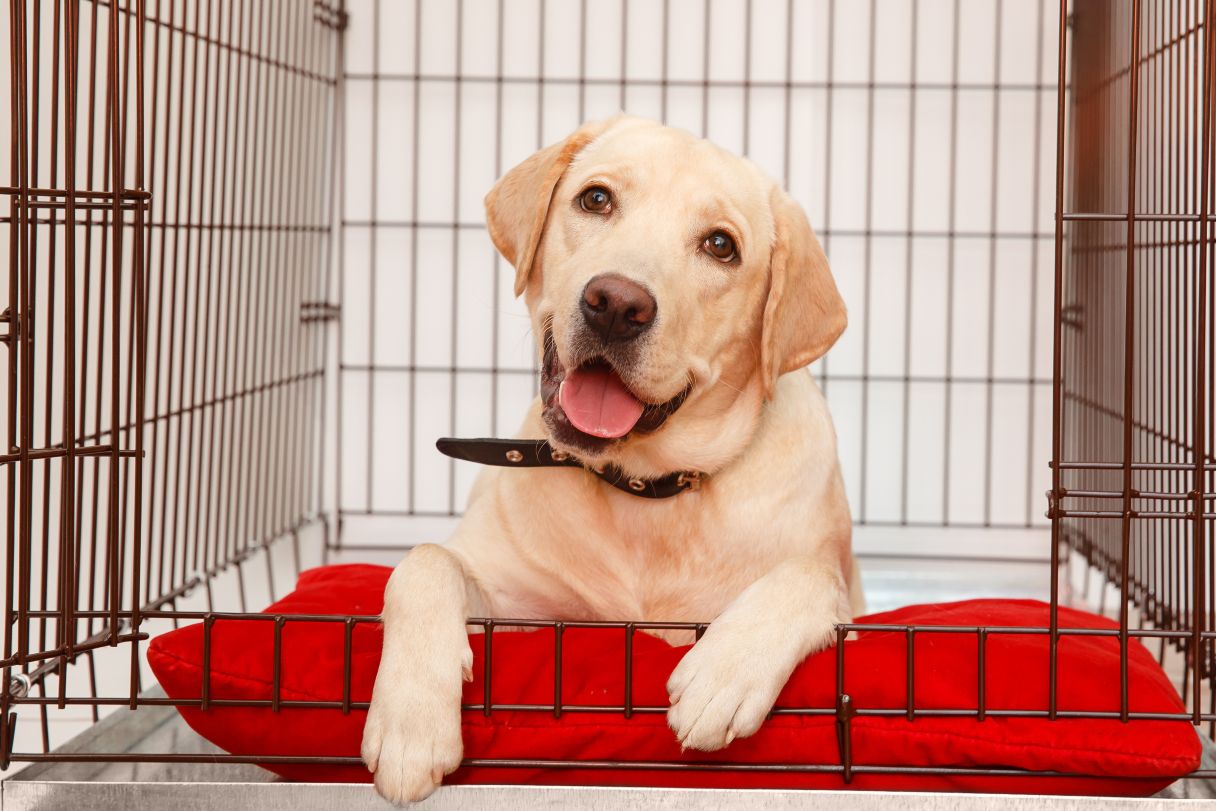
Crate training is recommended when you have to leave your puppy or dog alone and they’re not fully house-trained. The idea is that the puppy or dog considers the crate to be their “den,” and they won’t eliminate in there — assuming you don’t leave them in there for too long.3
How to choose a dog crate
Choosing the right size crate is essential, and many come with partitions that allow you to expand the space as they grow.3 Your puppy or dog should have enough space to lie down, sit, stand up and turn around, but not enough room to walk around or play. This can help discourage them from peeing in one corner and then moving to sleep in another.6
Be sure that the crate provides proper ventilation, and add a cozy, comfortable bed to create a safe and inviting den.6
Troubleshooting Common House-Training Problems
Even with your best efforts, your puppy or dog can have setbacks from time to time. Whether your pup starts having accidents again, gets distracted easily or just seems to forget what they’ve learned, it’s all part of the process. The key is to stay patient, identify what’s causing the issue and make small adjustments to get back on track.4
First, if your dog is reliably house-trained and starts having accidents, it may be worth a vet visit to rule out a urinary tract infection.7 If your puppy or dog just can’t seem to get the hang of it, it’s also worth taking them to the vet to make sure there isn’t another medical condition going on.2
Besides that, other problems with your dog having accidents usually relate to:3
- Giving them too much freedom too soon (Keep them close.)
- Keeping them in the crate for too long (If you have to be away from home for work and can’t take them out, consider hiring a dog walker or asking a friend to stop over and let them out.)
- Not giving them enough opportunities to “go potty” (Take them out more often.)
- Not giving them enough time to learn (Be patient, and stay consistent.)
If your dog pees out of excitement or fear, that is not a house training issue and may be worth consulting a dog trainer for help with the behavioral aspect.2
Effectively House Training for the Long-Term
House training takes time, patience and consistency, but your efforts will pay off. By using positive reinforcement, setting a steady routine and addressing challenges calmly, you’ll strengthen your bond and set your pup up for lifelong success. And remember: Accidents are part of the process, but with understanding and persistence, just about every pup can learn good house habits.
CareCredit Credit Card Financing for Dogs
The CareCredit credit card provides a convenient way to pay for your dog’s vaccinations and other health and wellness expenses, including exams, medications and products at providers in the CareCredit network.* Continue your wellness journey by downloading the CareCredit Mobile App. You can find a provider on the go, manage your CareCredit account and easily access the Well U blog for more great articles, podcasts and videos. Use our Acceptance Locator to find a veterinarian that accepts CareCredit to help keep your pet healthy and happy for a lifetime of love.
In addition to pet care, you can also use your CareCredit credit card for dentistry, cosmetic, vision, hearing, health systems, dermatology, pharmacy purchases, spa treatments and so much more within the CareCredit network. How will you invest in your health and wellness next?
Author Bio
Abbie Mood is a freelance writer with more than 15 years of experience. She has worked with clients of all sizes to create compelling content and she has written for the American Kennel Club, Marriott Bonvoy, Women’s Health Online, Headspace and more.

Related Tags
Want to share this on social media?






 VIDEO
VIDEO
 ARTICLE