 Search

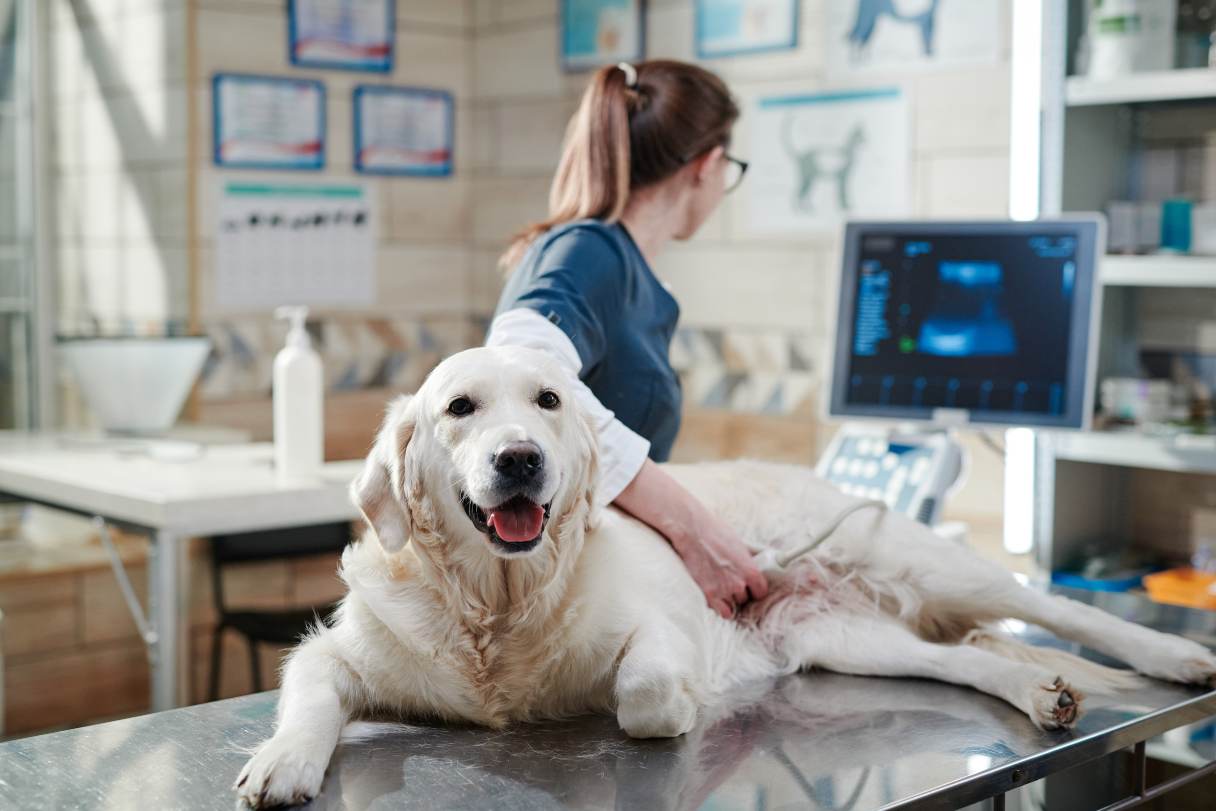
If you suspect your pup has swallowed something (you could have sworn you had two socks, not just one), appears to have bumps or lumps that were not there before or just seems like they're not their usual self, you may want to pay a visit to your vet — and an ultrasound may be needed.
Read on to find out how an ultrasound can be helpful in diagnosing issues with your pet, what an ultrasound for your dog costs and how the procedure works.
Why Your Dog May Need an Ultrasound
An ultrasound, also called ultrasonography, is a non-invasive way for your veterinarian to see your dog's internal body structures when there is a potential injury, health concern or suspected pregnancy.1
Ultrasounds for dogs can be a useful tool in diagnosing a variety of health conditions, including internal blockages, masses (like cysts or tumors), injuries, heart issues and foreign objects.2 Ultrasounds provide a two-dimensional (2D) image to help veterinarians see the size, shape and texture of tissues and organs.1 This technology is also used to both confirm and monitor pregnancies in dogs.1
An ultrasound for your dog may be recommended when your veterinarian needs to get a closer look at your dog due to concerns about:3
- A mass or tumor
- Abnormalities in blood work or urine tests (which may indicate kidney or bladder issues)2
- Gallbladder infections
- Heart conditions2
- Inflammation of the prostate
- Liver damage
- Lymphoma
- Pancreatitis
- Pregnancy
- Uterine infections
- Your dog swallowing a foreign object2
The procedure is painless.1 However, younger dogs, dogs who get anxiety in unfamiliar environments or dogs in pain may need sedation for a stress-free ultrasound.2 Your dog may also need an anesthetic or heavy sedative if a biopsy is required.1
How Much Does a Dog Ultrasound Cost?
The national average cost* for a dog ultrasound is $483, with costs ranging from $383 to $880.4
There are several factors that can affect how much an ultrasound costs for your dog4:
- Breed of dog
- Whether a specialist needs to examine the ultrasound, which may increase the cost
- Your location and accessibility to a veterinarian with ultrasound equipment
Cost of dog ultrasound by type
Different types of ultrasounds or more complex imaging have varying costs. Note that these costs do not include sedation or anesthesia:4
| Type | Average cost | Cost range |
|---|---|---|
| Ultrasound | $483 | $383 to $880 |
| Echocardiogram (heart) | $415 | $331 to $805 |
Calculate the cost of a dog ultrasound near you*

Explore costs in your area
Average Cost of Dog Ultrasound by State/District
Here's a breakdown of the average cost* of a dog ultrasound by all 50 states and the District of Columbia:4
| State/District | Average cost |
|---|---|
| Alabama | $407 |
| Alaska | $573 |
| Arizona | $499 |
| Arkansas | $401 |
| California | $644 |
| Colorado | $487 |
| Connecticut | $519 |
| Delaware | $473 |
| District of Columbia | $654 |
| Florida | $476 |
| Georgia | $424 |
| Hawaii | $865 |
| Idaho | $472 |
| Illinois | $436 |
| Indiana | $417 |
| Iowa | $412 |
| Kansas | $402 |
| Kentucky | $430 |
| Louisiana | $428 |
| Maine | $507 |
| Maryland | $533 |
| Massachusetts | $676 |
| Michigan | $421 |
| Minnesota | $442 |
| Mississippi | $386 |
| Missouri | $410 |
| Montana | $478 |
| Nebraska | $433 |
| Nevada | $469 |
| New Hampshire | $524 |
| New Jersey | $530 |
| New Mexico | $434 |
| New York | $570 |
| North Carolina | $453 |
| North Dakota | $422 |
| Ohio | $437 |
| Oklahoma | $396 |
| Oregon | $518 |
| Pennsylvania | $443 |
| Rhode Island | $522 |
| South Carolina | $445 |
| South Dakota | $429 |
| Tennessee | $419 |
| Texas | $427 |
| Utah | $477 |
| Vermont | $531 |
| Virginia | $466 |
| Washington | $529 |
| West Virginia | $389 |
| Wisconsin | $449 |
| Wyoming | $444 |
How an Ultrasound for Dogs Works
Some veterinarians are trained in ultrasonography, but others may need to refer you to a specialist for the procedure or send the images to a specialist for review.1
To prepare for your dog's ultrasound, your vet may ask you to withhold food and/or water for eight to 12 hours before the procedure. It's also important to let the veterinarian or specialist know about any medications your dog is taking, especially if they are not your regular vet. Certain medications can affect ultrasound results and/or interact with a sedative.2
Ultrasounds are non-invasive, but it's important for the handheld probe to make contact with the skin, so your vet will likely shave the area of your dog that they’re doing to examine.1
The results are typically available immediately unless further consultation with a veterinary radiologist is needed. If this is the case, it usually takes a few more days for the report to be finalized.1
Ultrasounds vs. Other Diagnostic Tools for Dogs
Ultrasound equipment sends sound waves into the body, which reflect off tissue and result in a 2D sonogram (picture).1 They do not use any radiation, which is why they're safe for pregnant dogs as well.2 However, they aren't effective for examining lungs or the skeletal system because the waves stop when they hit bones or pass through air with nothing to reflect off.1
An ultrasound of the heart, often called an echocardiogram, shows the heart walls, chambers and valves.2
Depending on what your vet is trying to diagnose, other imaging procedures may be recommended, including:5
- X-ray. This is best for seeing major abnormalities, joint or bone injuries, dental issues or foreign objects. X-rays may require sedation and are limited to a 2D view.
- Computed Tomography (CT) scan. This is best for examining bony and soft tissue structures in great detail. CT scans are similar to X-rays but usually require anesthesia and offer a three-dimensional view.
- Magnetic Resonance Imaging (MRI). This is best for diagnosing injuries in the organs, tissues and ligaments. An MRI might require general anesthesia.
Whether your pup has swallowed a toy, is predisposed to certain diseases or may be pregnant, an ultrasound is a powerful, non-invasive diagnostic tool that can help your veterinarian better understand what's going on. If you notice anything abnormal about your dog's health or behavior, consult your veterinarian right away for an evaluation.
CareCredit Credit Card Financing for Dogs
Taking good care of your pet's well-being from nose to tail is essential. Make sure to stay up to date on their regular checkups at the vet to help keep your pet happy and healthy for a lifetime of love. You can use your CareCredit credit card for pet care throughout the year for routine veterinary services as well as emergencies and surgeries.** Use our Acceptance Locator to find a veterinarian near you that accepts CareCredit.
CareCredit is there for you and your pet every step of the way; continue your wellness journey by downloading the CareCredit Mobile App to manage your account, find a provider on the go and easily access the Well U blog for more great articles, podcasts and videos.
In addition to pet care, you can also use your CareCredit credit card for dentistry, cosmetic, vision, hearing, health systems, dermatology, pharmacy purchases, spa treatments and so much more within the CareCredit network. How will you invest in your health and wellness next?
Author Bio
Abbie Mood is a freelance writer with more than 10 years of experience. She has worked with clients of all sizes to create compelling content and has written for the American Kennel Club, Marriott Bonvoy, Women's Health Online, Headspace and more.

Related Tags
Want to share this on social media?





 ARTICLE