 Search
3 Keys To Unlocking Case Acceptance
In this “Success Strategies” column, dental coach Sophia Dunkley and her client Dr. Appolon discuss how three simple shifts in mindset and processes can help increase case acceptance.
By Synchrony Health & Wellness
Nov 20, 2026 - 5 min read



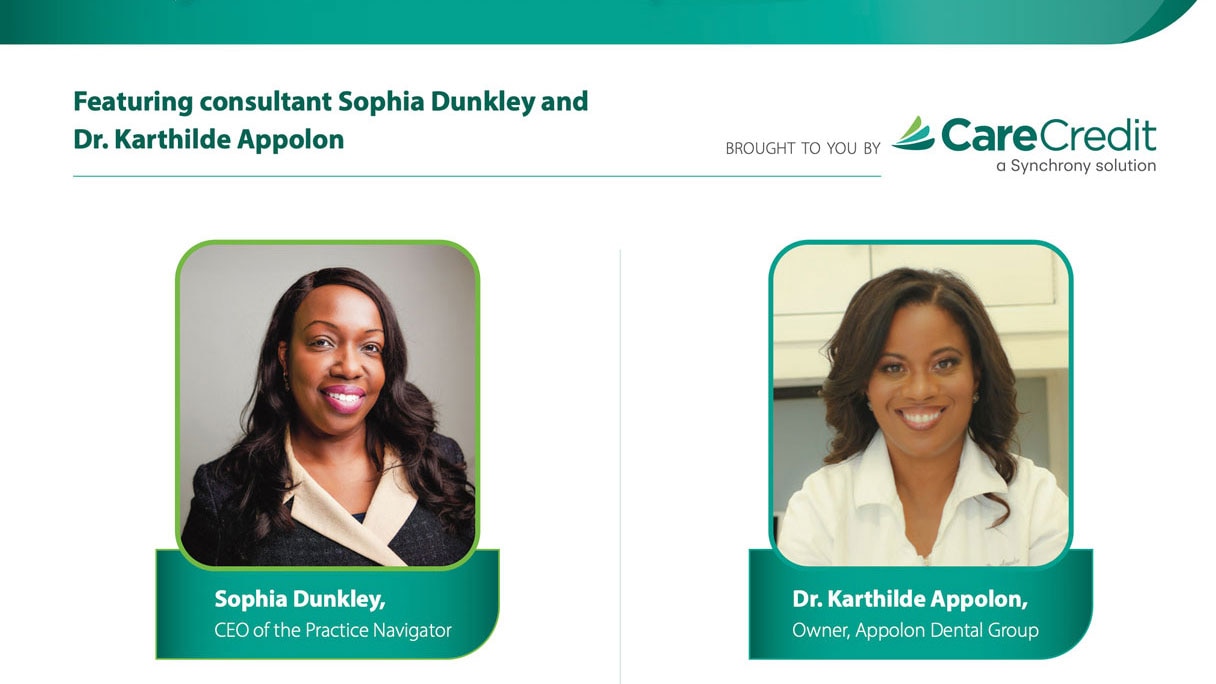
As CEO of the Practice Navigator, Sophia Dunkley is a popular practice management coach, consultant and speaker. She has front-line experience as an office administrator, practice manager and director of operations. Her focus is case acceptance coaching and helping practices increase profitability.
Dr. Karthilde Appolon is the owner of Appolon Dental Group, a thriving practice in New York that provides a range of services from cosmetic dentistry to TMJ treatment. She loves to give hope to people who thought their situation was hopeless, knowing dentistry can truly change lives. She is a member of GNYACD, AAWD, AGD and is a graduation of LVI Global.
In this "Success Strategies" column (download now), Dunkley and Dr. Appolon explore how three straightforward shifts in thinking and workflow can help boost case acceptance.
Dunkley: I have worked with Dr. Appolon for years. In fact, I helped open her practice. She really knows how to create that connection with the patient, and value and urgency for the dentistry. The biggest challenge we have is getting the team to get into that mindset and then routinize key verbal skills to gain understanding of what the patients want so you can provide that to them. That is the foundation of case acceptance.
Dr. Appolon: Case acceptance is key. Without case acceptance there is no practice. Two of the most impactful communication skills that Sophia has integrated into our team's verbal skills are the dual alternative close and an understanding of whether the barrier to care is an internal or external block.
Dunkley: Those are two very powerful skills. The dual alternative close should be part of every single treatment and financial conversation. It's easy for the team to understand and takes a bit of pressure off of them because proceeding with care is ultimately up to the patients.
What we do to increase case acceptance is to give patients two to three choices that enables them to make a care decision that is in their best interests – emotionally, clinically and financially. Simply put, never end a treatment presentation with a simple one choice, because it becomes 'this' or nothing. Instead, give them two, but not more than three, options.
For example: "Mr. Brown, you have two treatment options, as Doctor Appolon has explained. You can do a root canal, post and a bridge or a root canal, post and an implant. If you do a bridge now, there is still a possibility you may have to do an implant later. Which treatment would you prefer?"
Dr. Appolon: Giving patients two or three choices is empowering. They want to be part of the decision. If you give them only one option, it's as if you are dictating care. Again, it's this or nothing. When you give choices with value statements and clarity, they can make their own decision. This is also part of the financial conversation. I'm not shy about offering financing to patients because I have found it increases case acceptance.
Dunkley: Yes! So when talking about payment options, give two or three options. Any more and you may confuse the patients. It's a delicate balance. Cash, credit cards and financing are the three to offer to every patient, every time. If the patient is interested in financing, you've now got to find the right payment plan. This is where trust comes in.
So many companies have come and gone in dental financing. So I look to the company that has longevity and is solely focused on health and wellness – like CareCredit – because financing needed dentistry is a bit different than financing car repairs.
Dr. Appolon: There must be transparency and clarity for the patient in terms of money. As a clinician, when we recommend a company, the trust the patient has in us is transferred. If that trust is violated and the patient is unhappy or paying for the great care we delivered becomes a burden, I feel really badly. I work hard to build long-term patient relationships.
People come in with a CareCredit credit card. That company has positive brand value. They trust CareCredit. I trust CareCredit.
Dunkley: Dr. Appolon mentioned internal and external blocks. It's really important for us to, as we're presenting financing, to have an understanding of who's in front of us and determine if the objections are internal or external blocks, especially the ones around money.
For example, if the patient is working hard just to make ends meet and is going to put the needs of their children before their own oral health, that's an external block. They want to go forward with care, they see the value, but they feel they are unable to do so because of their financial circumstances. Financing may help some of these patients, but we don't want them to be approved for financing if that creates a burden.
If the patient objection is internal, it's more about their beliefs, values and assumptions. They believe dentistry is expensive or unnecessary "until it hurts." That's where we have a bit more work to do to gain clarity and help the patient understand the benefits of care and the possible issues with delaying treatment.
Dr. Appolon: One thing to note here is that dentists and office managers also have internal blocks. They may assume that the patient will never be able to afford a large case or that they don't "want" a financing option like CareCredit. Even people who have the money in a bank account for a large case may appreciate and prefer to use promotional financing. Having these internal blocks can derail case acceptance.
Dunkley: Absolutely. It's important to understand that when a patient says, "I want to think about it," that doesn't necessarily mean no forever.
Dr. Appolon: So true. If we've done a good job with the patient, I feel they will be back when the timing is right. I think every practice has opportunity for growth. Sophia has shown me that with the right processes in place I can do exactly what I want – more of the dentistry I love doing.
 Download PDF
Ready to help more patients and clients get the care they want and need?
Get Started
Related Content
View All

 Articles


Ready to help more patients and clients get the care they want and need?
Get Started*Subject to credit approval. See carecredit.com for details.
The information, opinions and recommendations expressed in the article are for informational purposes only. Information has been obtained from sources generally believed to be reliable. However, because of the possibility of human or mechanical error by our sources, or any other, Synchrony and any of its affiliates, including CareCredit, (collectively, “Synchrony”) does not provide any warranty as to the accuracy, adequacy or completeness of any information for its intended purpose or any results obtained from the use of such information. The data presented in the article was current as of the time of writing. Please consult with your individual advisors with respect to any information presented.
© 2026 Synchrony Bank.